- HES@hiroshima-energysupply.com
- 0919316889
Liquefied petroleum gas (LPG) is one of the important energy sources and is widely used in many fields, from civil to industrial. Understanding LPG and its basic properties helps users to utilize it effectively and ensure safety during use.
LPG (Liquefied Petroleum Gas) is a mixture of flammable hydrocarbon gases, primarily propane (C₃H₈) and butane (C₄H₁₀). These gases are liquefied by compression under pressure or refrigeration, making them easy to transport and store. LPG is commonly produced during natural gas processing and petroleum refining.
Propane (C₃H₈): Colorless, odorless, flammable gas with high calorific value.
Butane (C₄H₁₀): Similar to propane, butane is also a colorless, odorless, and flammable gas, but has a higher boiling point than propane.
The blend ratio between propane and butane in LPG can vary depending on the intended use and climatic conditions.
Status: Under normal pressure and temperature conditions, LPG exists in gas form. When compressed or cooled, it turns into liquid form, reducing volume and making it convenient for transportation and storage.
Proportion: LPG in liquid form is lighter than water (specific gravity about 0.5 - 0.58) and in gas form is heavier than air (specific gravity about 1.5 - 2 times).
Steam pressure: LPG has a high vapour pressure, which increases with temperature. Therefore, LPG containers must be designed to withstand this pressure.
Boiling point: Propane has a boiling point of about -42°C, while butane has a boiling point of about 0°C.
Flammability: LPG is flammable and produces a blue flame when burned, providing high thermal efficiency and low soot production.
Explosion range: LPG has an explosive limit in air from about 2% to 10%, which means that if the concentration of LPG in air is within this range, the mixture can ignite or explode when exposed to a source of ignition.
Non-toxic: LPG is not toxic, but when leaked in a confined space it can displace oxygen and pose a suffocation hazard.
Colorless, odorless: In nature, LPG is colorless and odorless. However, to easily detect leaks, people often add characteristic odorants to LPG.
In civil: LPG is widely used as fuel for gas stoves, heaters and hot water systems.
In industry: LPG is used in production processes that require high temperatures such as baking, drying, welding and cutting metals and as fuel for machinery.
In transportation: LPG is used as fuel for some vehicles, known as autogas, which helps reduce environmental pollution.
In agriculture: LPG is used for drying agricultural products, sterilization and insect control.
LPG is stored in high-pressure vessels, ranging from small household cylinders to large industrial tanks. Transporting LPG requires strict adherence to safety regulations to avoid the risk of leakage and explosion. 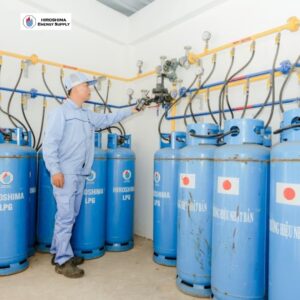
Leak test: Regularly check connections and pipes to promptly detect leaks.
Ventilation: Use LPG in a well-ventilated space to avoid gas build-up.
Equipment maintenance: Ensure LPG appliances are regularly maintained and in good working order.
Proper storage: LPG cylinders should be placed in a cool, dry place, away from heat and fire. 
High performance: LPG provides high thermal energy, saving time and money.
Environmentally friendly: Compared to other fossil fuels, LPG burns cleaner, reducing greenhouse gas emissions and pollutants.
Convenient: Easy to transport and store, suitable for a variety of applications.
Safe: Risk of fire or explosion if not used and stored properly.
Depends on the supply: LPG prices and supplies may fluctuate due to the influence of the world oil market.
LPG is an important energy source with many diverse applications in life and industry. Understanding the basic properties of LPG helps users exploit it effectively and ensure safety during use. To achieve optimal efficiency and safety, choosing a reputable LPG supplier is very important. Hiroshima Energy Supply is proud to be a supplier of high quality LPG, meeting all safety standards and committed to providing the best service to customers.


 EN
EN  VI
VI  JA
JA
Leave a comment